































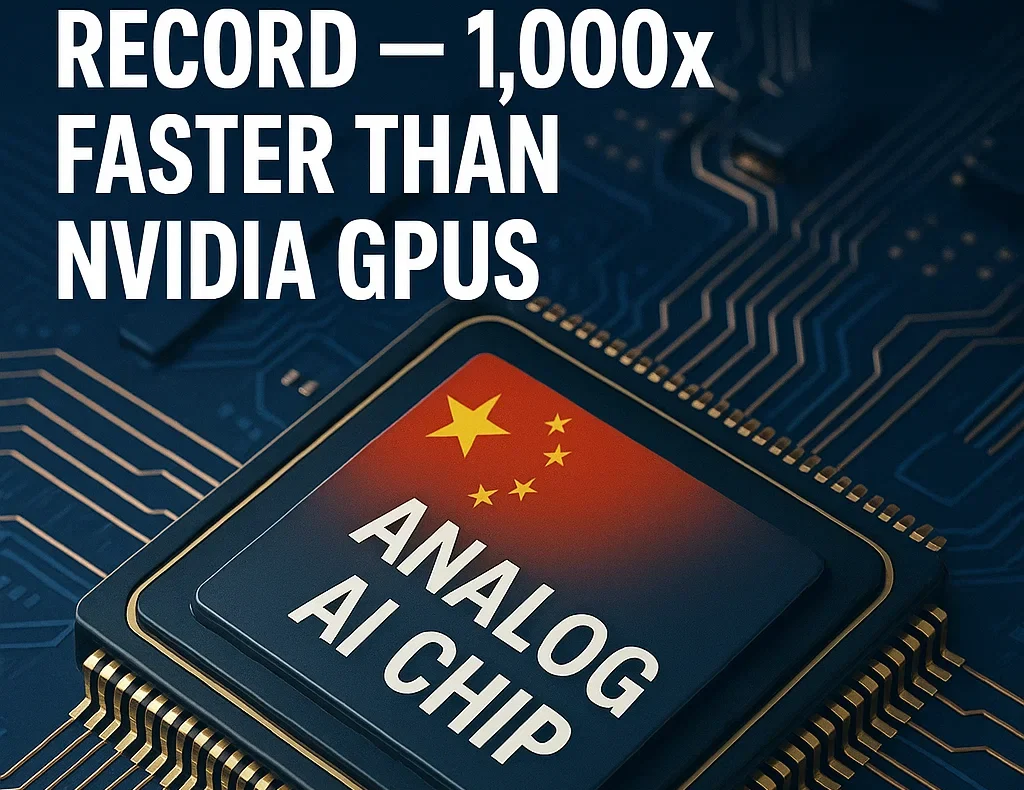
New Chinese Analog AI Chip Sets Record — 1000x Faster Than Nvidia GPUs
In a major scientific breakthrough, Chinese researchers have unveiled a next. Generation analog AI chip that can perform complex calculations directly on its physical circuits. Making it up to 1,000 times faster than Nvidia’s latest GPUs.
⚙️ Revolution in AI Processing
Published in the journal Nature Electronics. The study highlights how this analog chip eliminates the traditional reliance on binary digital processors. Instead, it executes computations using resistive random-access memory (RRAM) arrays, enabling data to be processed within the hardware itself.
This design not only speeds up performance but also addresses long-standing challenges in energy efficiency and data transfer bottlenecks, especially in emerging technologies such as 6G networks and advanced artificial intelligence.
⚡ Unmatched Speed and Efficiency
The research team claims that their analog chip can match the precision of digital processors while consuming 100 times less energy. Benchmark tests reveal that it achieves up to 1,000x higher throughput compared to current high-end GPUs from Nvidia and AMD.
According to the researchers, “With the rise of applications using vast amounts of data, this creates a challenge for digital computers, particularly as traditional device scaling becomes increasingly difficult. Our analog computing approach could offer a 1,000 times higher throughput.”
🧠 Solving Century-Old Computing Problems
For decades, scientists have grappled with the “century-old problems” of analog computation — namely poor precision, limited scalability, and instability. This new chip reportedly solves these issues, combining analog speed with digital-level accuracy.
By processing data in-memory, it avoids the need to move information between memory and processors — one of the biggest causes of latency and energy waste in current computing systems.
🌐 Impact on Global AI and 6G Technology
Experts believe this innovation could mark a turning point for AI acceleration, edge computing, and next-generation wireless systems. With its immense speed and low power requirements, the chip may redefine how AI models are trained and deployed — especially in fields like robotics, IoT, and smart cities.
This breakthrough also showcases China’s increasing strength in semiconductor innovation. Signaling growing competition in a sector long dominated by U.S. chipmakers.



[…] New Chinese Analog AI Chip Breaks Record—1000x Faster Than Nvidia GPUs […]